
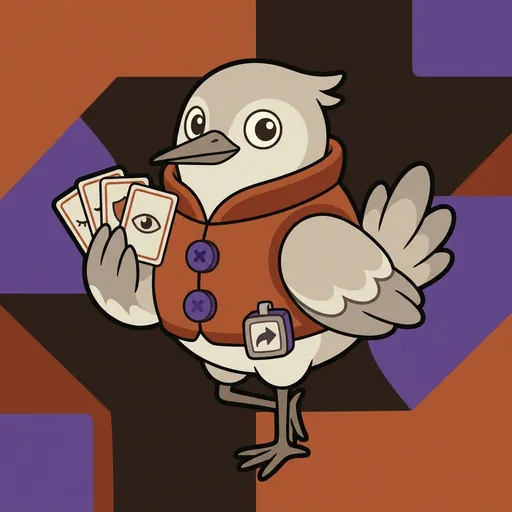
Bide
BIDE — *slow is a move too. sometimes the best move is to wait.*
Listen along — Bide
Loading audio…
Press play to listen along. The line being read lights up as you go.
Show full transcript
Loading transcript…
Chapter 4 — Bide and the Move That Is Waiting
Bide stood at the edge of the pond so still that a dragonfly landed on his beak, and he let it.
He was a small heron, warm-grey and chunky, with a soft chunky vest and a way of holding perfectly, perfectly steady. His students had gathered to watch him fish, expecting a great lunge. Instead he just… waited. Minutes passed. A fish drifted near, saw nothing to fear from the statue-heron, and drifted closer.
Then — one clean, unhurried dip — and the fish was his. No splash. No scramble. The other fish never even scattered.
A young otter named Dash, who had been fidgeting the whole time, threw up his paws. “You didn’t do anything for ten whole minutes!”
“I was doing the hardest thing,” Bide said, swallowing. “I was waiting on purpose.” He set down his catch. “Slow is a move too, Dash. Sometimes the best move is to wait — and let the other fellow move first.” He nodded at the pond, calm again. “The heron who lunges scares the fish. The heron who waits eats.”
Dash’s tail twitched. He didn’t understand yet. But he stopped fidgeting, just for a moment, and watched the still water.
Bide grew up beside that same big water, in a family of heron fishers famous throughout the village for standing still.
The first morning his father took him fishing, little Bide’s legs ached from holding position, and a fat, gleaming fish swam right past his feet. His whole body screamed now, NOW, grab it — and he lunged. Splash. The fish shot away, and so did every other fish in reach. He stood in the churned-up water with an empty beak and a burning face.
“Watch this,” his father whispered, and settled into stillness beside him.
A neighbor heron nearby lunged the way Bide had — splash, nothing. But Bide’s father did not move. He waited while the water calmed, while the frightened fish forgot and returned, while one big one swam close and unworried. Only then, slow and smooth, did his father dip and rise with a fish.
“See?” his father said. “The lunge feels like doing something. But stillness is action. Waiting is a move — it makes the water calm and brings the fish to you.” He tapped Bide’s shaking leg with his own. “The itch to move is not the same as a good move.”
Bide swallowed the lesson whole and carried it out of the water with him.
When Bide turned twelve he walked to StrategyForge, where a badger named Gambit set out a chessboard.
“Your move,” Gambit said. Bide looked. There was no crashing attack here, no piece to grab. His old itch flickered — do something! — but he breathed it down. He picked up his knight and quietly slid it to a better square, improving his position by an inch, forcing nothing.
“That’s a small move,” Gambit said, testing. “Why not attack?”
“Because no attack helps me yet,” Bide said. “So I make my house a little stronger and let him commit first. Whoever has to move into trouble often loses.” He paused, careful. “This is patient planning, not a gamble — I’m not betting on luck, I’m building until waiting itself becomes the strongest thing on the board.”
Gambit’s eyes crinkled. “Come teach the restless ones,” he said.
Now Dash the otter sat across the workshop board, tapping every part of himself that could tap.
“I see it! Queen goes here — huge attack!” Dash reached for the piece.
“That is a move,” Bide said gently, catching his paw. “But look — it leaves your own king in the open. It feels strong because moving feels good. Watch a quiet one instead.” He slid his knight to a better square. It attacked nothing. “Now he has to answer, and I’ve gotten a little stronger for free. That’s a waiting move — it improves my house without forcing my hand.”
Dash slumped. “But I have to do something. It’s my turn!”
“That jumpy feeling has a name — action-bias, the itch to move for the sake of moving.” Bide set a small smooth stone on the table between them, calm and heavy. “Feel how the stone just sits? A patient position is like that. It gets stronger by waiting.”
He set up one more board. “Look here. Every single move he can make will hurt him — I’ve boxed him in so gently that motion itself is a trap. That’s what waiting can build.”
Dash’s eyes went wide. “So do I guess which bad move he’ll pick? Like a bet?”
“No guessing, no bets,” Bide said softly. “I designed the box by being patient. His trouble is my planning, not my luck.” He nudged the stone toward Dash. “I wait. He must move. My patience did the work.”
Dash picked up the little stone and held it. For the first time all day, his paws went quiet.
Bide let the pond-quiet fill the workshop, and Dash sat with the stone in his palm.
“That whole time you were fishing,” Dash said slowly, “I felt like I was going to burst. Right here.” He pressed the stone to his chest. “Like an itch I couldn’t scratch.”
“I know that itch,” Bide said. “I lunged once and scared away every fish in the pond.” He smiled. “The itch fades if you let it. It’s not asking you to move — it’s just noise. Underneath it there’s a quiet you can stand on.”
Dash breathed out long and slow, and felt the jumpy hurry-up feeling in his chest loosen its grip — melting into something steady and unhurried, the calm of a heron who knows the fish will come.
The StrategyForge ensemble
Bide is part of StrategyForge's distributed-narrative cast. Each character embodies a different curricular primitive; together they teach the full subject.
-

Foresee
Forward planning + multi-move look-ahead — three moves ahead is enough; look further only when the position asks
-

Trade
Piece-value reasoning + exchange evaluation — equal value isn't equal worth; position-value matters more than piece-value
-

Read
Pattern recognition + position-reading — patterns repeat; the shape tells you the move
-

Concede
Graceful loss + post-game analysis — losing is a teacher; winning is too; I write down both