Foresee
FORESEE — *three moves ahead is enough; look further only when the position asks.*
Listen along — Foresee
Loading audio…
Press play to listen along. The line being read lights up as you go.
Show full transcript
Loading transcript…
Chapter 1 — Foresee and the Three Moves That Are Usually Enough
The chessboard sat between Foresee and the tall clock, and she had not touched a single piece yet.
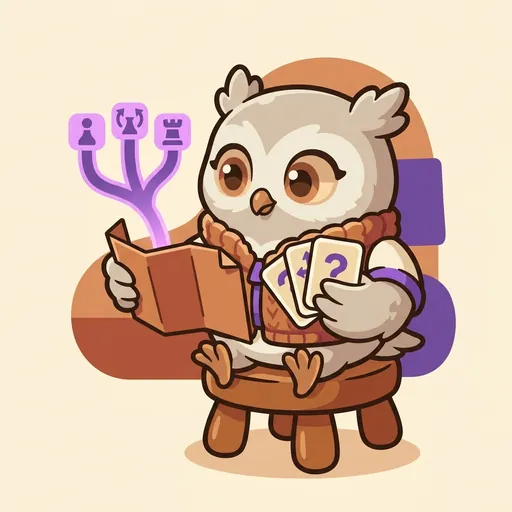
She was a small owl, chunky and soft as a cushion, with big eyes that blinked slowly. Her students called her slow. She didn’t mind. Right now she was looking at three squares — only three — and moving her wing a tiny bit above each one, like she was tapping stepping-stones across a stream.
“If I go here,” she murmured, touching the first square, “then he probably goes there.” Her wing drifted to the second square. “And then I go here.” The third. She stopped. She smiled. She picked up the knight and set it down with a soft click.
A young rabbit named Sprint, watching from the next stool, groaned. “That’s it? You only looked at three moves? My brother says the great players see twenty moves ahead. Twenty!”
Foresee tilted her head. “Does your brother win?”
“Well — no. He mostly stares at the board until his time runs out.”
“Ah.” Foresee tapped the three squares again, one, two, three. “That is because twenty moves is a story you tell yourself, and stories get tangled. Three moves is a path you can actually walk.” She moved her wing across the little bridge of squares once more, unhurried. “My move. His move. My move. That is usually enough to know if the road is good.”
Sprint frowned, but he leaned in closer. He was watching her wing now, not the clock.
Foresee grew up in the high tower at the edge of the village, where her family kept the night watch. Owls, all of them, perched at the great window from dusk to dawn.
The first night her grandmother let her watch alone, little Foresee tried to track everything at once — every shadow in the valley, every ripple in the far river, every fox that might, someday, maybe, come near the sheep. Her eyes darted and darted. By midnight her head throbbed and she’d missed the one thing that mattered: a lamb wandering right below the tower.
Her grandmother settled beside her the next night. “You watched too far,” the old owl said gently. “Watch the near dark first. What comes tonight? What comes with the next gust of wind? What comes after that?” She swept a wing across the sky in three slow arcs — near, nearer, nearest home. “Then rest your eyes. The far valley can keep.”
Foresee tried it. Near. Nearer. The step after. Her head stopped aching. And when the fox came slinking up the near slope, she saw it in plenty of time, because she had not spent herself staring at stars.
“Three arcs of the sky,” her grandmother said. “Almost always enough.”
When Foresee turned twelve she walked down from the tower to StrategyForge, where a badger named Gambit kept the workshop.
He set a board between them and said nothing. Foresee looked at it. She did not count to twenty. She reached out and touched three squares in a row — this, then this, then this — walking the little bridge with the tip of her wing, and then she made her move.
Gambit’s eyebrows went up. “You didn’t look deeper.”
“The road was clear after three steps,” Foresee said. “I’d only tire my eyes looking further, and miss what’s right here.”
Gambit turned the board sideways. A tangle now — pieces locked, a capture that would force another capture. Foresee’s wing kept going this time. One, two, three, four, five squares, following the chain like a rope pulled taut. “Here the road asks me to look further,” she said. “So I do — but only because it asked.”
The badger let out a low chuckle and pushed the board aside. “Come teach,” he said.
Now Sprint the rabbit sat across from her, still restless, still glancing at the clock.
“Watch my wing, not the timer,” Foresee said. She set up a plain position. “This one is calm. So — my move.” She touched a square. “His most likely reply.” A second. “My answer to that.” A third. She lifted her wing away. “The bridge holds. I can decide.”
“But what if he does something you didn’t guess?”
“Then I stand on the near square and build the next three steps from there.” She smiled. “I don’t have to see the whole valley. I only have to see the ground under my next few feet.”
She set up a second board — knotty, sharp, a forced chain waiting. “Now feel the difference.” Her wing walked further this time, five squares, six, tracing the captures that had to happen. “This position is tugging my eyes forward. So I follow. Deep looking is a tool I pick up when the board hands it to me — not a rule I carry everywhere.”
Sprint stared at the two boards, one calm and one knotty. Then, slowly, he reached out his own paw and tapped three squares on the calm one. One. Two. Three. He stopped himself before the fourth. He grinned, surprised at himself.
“There,” Foresee said softly. “You felt where to stop.”
The clock ticked. Sprint didn’t flinch at it anymore.
He sat back and let out a long breath, the kind that comes when you set down something heavy you didn’t know you were holding. “I always thought I had to see everything,” he said. “It made my chest go tight, like there wasn’t enough room to breathe.”
“I know that tight feeling,” Foresee said. She rested a wing over his shoulder, light as a leaf. “It’s the feeling of trying to hold the whole sky. You can put it down. You only ever needed the near dark.”
Sprint nodded. And for the first time all afternoon he wasn’t rushing — just sitting, calm and roomy inside, watching three quiet squares and feeling, at last, like there was enough air.
The StrategyForge ensemble
Foresee is part of StrategyForge's distributed-narrative cast. Each character embodies a different curricular primitive; together they teach the full subject.
-

Trade
Piece-value reasoning + exchange evaluation — equal value isn't equal worth; position-value matters more than piece-value
-

Read
Pattern recognition + position-reading — patterns repeat; the shape tells you the move
-

Bide
Patience + tempo discipline — slow is a move too; sometimes the best move is to wait
-
Concede
Graceful loss + post-game analysis — losing is a teacher; winning is too; I write down both