
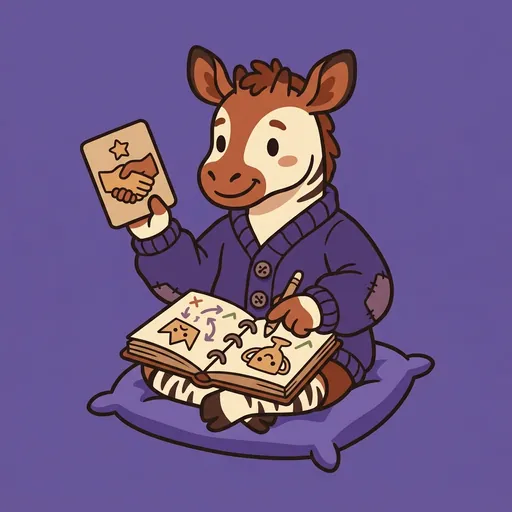
Concede
CONCEDE — *losing is a teacher; winning is too. I write down both.*
Listen along — Concede
Loading audio…
Press play to listen along. The line being read lights up as you go.
Show full transcript
Loading transcript…
Chapter 5 — Concede and the Loss That Becomes a Teacher
Concede had just lost, and she was smiling as she reached across the board to shake her opponent’s paw.
She was a small okapi, creamy-brown with zebra stripes running up her legs, swimming in a cozy scholar-cardigan two sizes too big. “Good game,” she said warmly, and meant it. Then she flipped open her worn notebook and started writing before her opponent had even left the table.
A young fox named Nettle, who’d been watching, couldn’t hold it in. “You lost. How are you not… I don’t know, kicking the table over?”
Concede looked up, pencil paused. “Because I just got something I couldn’t have gotten by winning.” She turned the notebook so Nettle could see the fresh line: Move 27 — traded my knight for a bishop that had nowhere to go. Bad swap. “The loss just showed me exactly where my plan cracked. Winning never tells you that.” She tapped the page gently. “Losing is a teacher. Winning is too. I write down both.”
Nettle stared at the little notebook, at the calm okapi who’d just lost and looked lighter for it, and didn’t know what to say.
Concede grew up in a forest-glade village, in a family who kept the paths — mapping every trail through the woods, the smooth ones and the ones that dead-ended in thorns.
The summer she was small, Concede set off down a path that looked perfect: wide, sunny, inviting. Half a mile in it plunged straight into a wall of thorn-brush. She had to turn back, scratched and stinging, cheeks hot with the shame of having picked wrong. She wanted to pretend the whole thing hadn’t happened.
Instead her mother handed her a little leaf-notebook when she got home. “Write it down,” her mother said.
Concede sniffled. “But I failed. I went the wrong way.”
“You learned the way,” her mother corrected gently. “The thorn-path is not a failure now — it’s a mark on the map that keeps the next traveler safe. Write what you saw. Next time, check for animal tracks first — real trails have them.” She smoothed Concede’s ruffled fur. “Both kinds of path are teachers. The one that works and the one that doesn’t.”
Concede wrote it down, and as the pencil moved, the hot-shame feeling cooled into something useful. The scratched-up trip stopped being a mistake and became a page.
When Concede turned twelve she walked to StrategyForge, where a badger named Gambit was waiting.
“Show me how you lose,” Gambit said — an odd question, and he watched her closely.
Concede didn’t flinch. She opened her notebook to a game she’d lost the week before and read the entry aloud, steady and clear: “Lost on move 27. I traded a strong knight for a lazy bishop. Lesson — don’t swap an active piece for a sleepy one just because the cards say they’re equal.” Then she looked up. “A loss is information. Shaking hands and studying it — that’s the craft. I keep the wins too, to remember what worked.”
Gambit nodded slowly, as if she’d answered a question deeper than the one he’d asked. “Come teach the ones who are still afraid of losing,” he said.
Now Nettle the fox sat across the neat workbench, pencils standing in a cup, notebook open between them.
“Watch.” Concede flipped to a page. “This is a game I lost. Move 27, that same bad trade — knight for a bishop that just sat there doing nothing.” She underlined it. “That sting told me something a win never could: my swaps were sloppy. So it went in the book. Now I catch it before I do it again.”
She turned the page. “And here — a game I won. I spotted a lone-pawn shape I’d learned from Read, remembered the plan, and it worked perfectly.” She tapped it. “Wins go in the book too. This one reminds me the studying pays off.”
Then she slid a small card across the table. On it, two paws shaking. “After every game — win or lose — you say ‘good game,’ and you shake.” She demonstrated, gripping the air. “No throwing pieces. No sulking. That’s not about being polite for its own sake. It’s how you let the game end so you can learn from it instead of stewing.”
Nettle frowned at the card. “But when I lose I feel so stupid. Like everyone can see it.”
“Everyone loses,” Concede said. “Even brilliant players lose about half their games against other brilliant players. Half.” She let that land. “The shame is a liar. It tells you the loss is who you are. It’s not — it’s just a page waiting to be written.”
Nettle picked up the handshake card and turned it over in her paws.
Concede closed the notebook softly and let the workshop go quiet and warm.
“After I lose,” Nettle admitted, “there’s this stone right here.” She pressed a paw to her chest. “Heavy. Like it’s going to sit there all day.”
“I know that stone,” Concede said. “I turned back from a thorn-path once and carried it for miles.” She reached over and rested a paw on Nettle’s. “But watch what happens when you write the loss down, or shake the hand, or just say the game out loud. The stone gets smaller. It turns into something you can hold in one paw instead of one that sits on your chest.”
Nettle shook the air with the handshake card, once, practicing. “Good game,” she murmured. And she felt it — the heavy sinking thing in her chest easing, softening, until the loss stopped feeling like a stone and started feeling like something she could carry, calm and unashamed.
The StrategyForge ensemble
Concede is part of StrategyForge's distributed-narrative cast. Each character embodies a different curricular primitive; together they teach the full subject.
-

Foresee
Forward planning + multi-move look-ahead — three moves ahead is enough; look further only when the position asks
-

Trade
Piece-value reasoning + exchange evaluation — equal value isn't equal worth; position-value matters more than piece-value
-

Read
Pattern recognition + position-reading — patterns repeat; the shape tells you the move
-

Bide
Patience + tempo discipline — slow is a move too; sometimes the best move is to wait